<=>
Less is More
Published: 24th February 2026
Category: Others
Shiva temples and mythology apart from their religious appeal are a study in minimalism. In Shaiva philosophy minimalism does not mean poverty but conscious renunciation. An awareness that real power & freedom comes from radical simplicity, and detachment from material excess. This year one of the greetings received by me on Shivaratri was poignant with meaning but a textbook reference for minimalism. I am reproducing it here for reference.
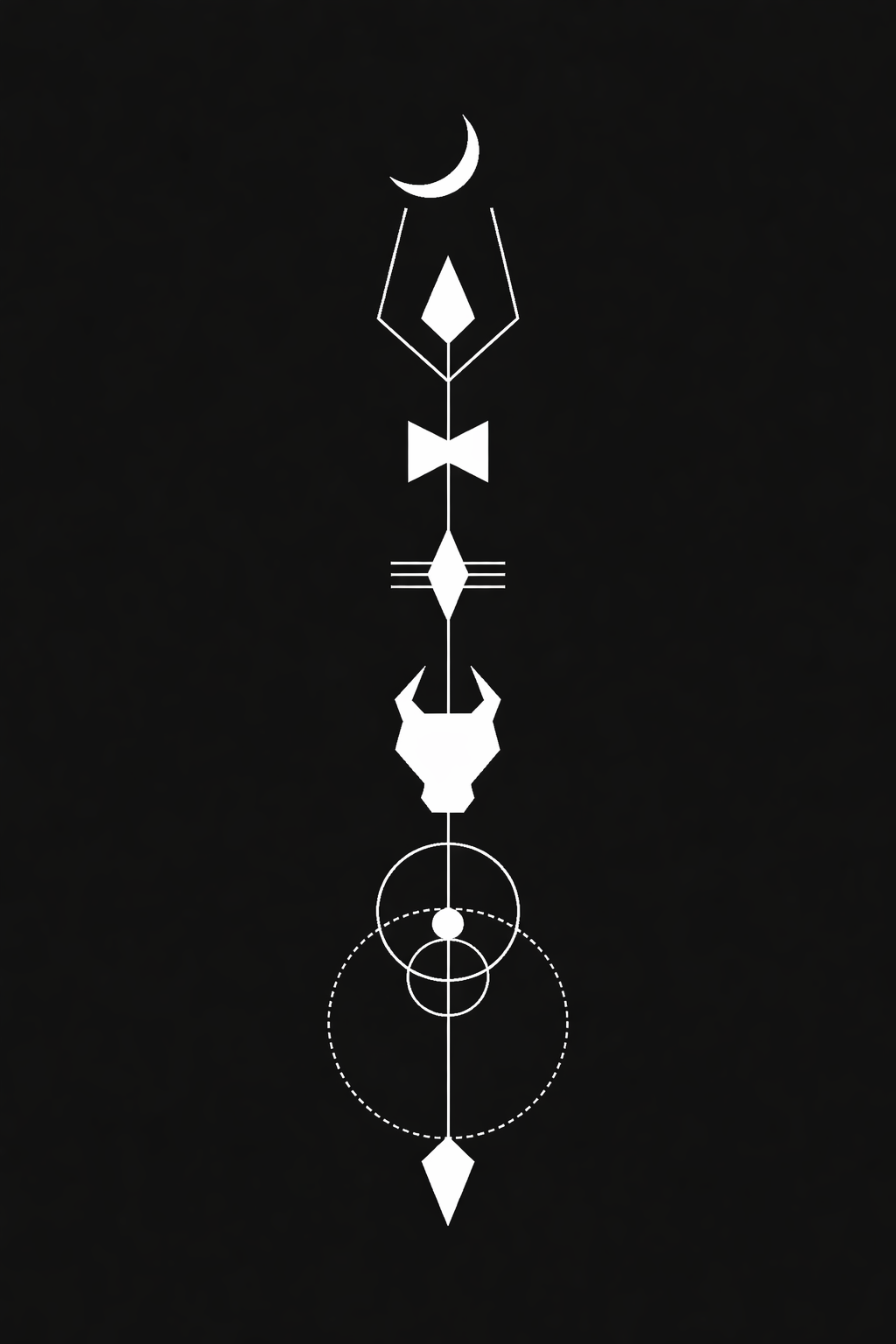
Religious symbols very often fail not because they lack meaning, but because they carry too much literalism. Over centuries, visual representations of divinity accumulate ornamentation, narrative detail, and cultural specificity. While these forms inspire devotion, they frequently obscure the metaphysical ideas they were originally meant to express. The above minimalist “logo” (can we call it that?) of Shiva is brilliant as it deliberately moves in the opposite direction. It strips Shiva of anthropomorphic depiction and reconstructs him as a vertical metaphysical principle using geometry, symmetry, and spatial hierarchy.
Its a stark representative of the minimalism as well as the duality of the deity. Each line, curve, and circle participates in a coherent conceptual system. What appears minimal at first glance reveals extraordinary density upon careful analysis. (Note: this is my understanding from my experience at various Shiva temples and discussions with people / books read. It may speak differently to you)
I. THE VERTICAL AXIS AS COSMIC PRINCIPLE The most striking feature of the logo is its strict vertical alignment. There is no lateral expansion or horizontal narrative. In Indian metaphysics, verticality represents transcendence. The axis mundi (the cosmic pillar) appears in multiple traditions as the connector between heaven and earth, the unmanifest and the manifest. In Shaivism, Shiva himself is this axis: unmoving, central, and absolute, while all activity unfolds around him. The vertical line in the logo simultaneously evokes: - The cosmic pillar (linga in its abstract sense) - The human spinal column - The Sushumna Nadi, the central channel of consciousness in a yogic anatomy. (Perhaps this is the reason we are asked to sit , keep the spine straight and meditate on Shivaratri) By collapsing cosmic, bodily, and metaphysical axes into one line, the designer asserts a core Shaiva idea: the human being is not separate from the cosmic order. The same structure governs both.
II. THE CRESCENT MOON: TRANSCENDENCE OF TIME At the apex sits the crescent moon. This is one of Shiva’s most ancient attributes, but here it is radically abstracted. The moon in Indian symbolism governs time, rhythm, and cycles. Days, months, tides, fertility — all respond to lunar movement. (I had a very interesting talk with the caretaker on this aspect but that will require a seperate article in itself). Shiva wearing the moon signifies mastery over time rather than submission to it. He does not exist within cycles; but he is simply beyond it. Placed at the very top, the crescent declares that the entire structure below unfolds under a consciousness that is timeless. Importantly, the moon is not full. The crescent suggests restraint, containment & not excess.
III.THE TRISHULA AND DAMARU: BALANCE AND VIBRATION Below the crescent appears a forked form suggesting the trident (Trishula), followed by an hourglass-like shape resembling the Damaru. The Trishula symbolizes triadic balance: - Creation, Preservation, Destruction - Past, Present, Future - Sattva, Rajas, Tamas Rather than depicting the trident as a weapon, the logo renders it as structure removing aggression and highlighting regulation. Shiva is the god of transformation and not destruction. The Damaru introduces sound. In Shaiva cosmology, vibration (nada) precedes form. The universe begins not with matter, but with rhythm. The Damaru represents this primordial pulse. Its placement above the eye but below the trident suggests that vibration is the medium through which cosmic principles become perceivable reality.
IV. THE THIRD EYE AND TRIPUNDRA: KNOWLEDGE AND IMPERMANENCE The section containing three horizontal lines with a central eye is the most explicit Shaiva reference. The three lines correspond to the Tripundra, sacred ash. signifying impermanence. Everything that appears solid will eventually reduce to residue. Wearing ash is not pessimism but it refers to clarity. The eye at the center is the Ajna Chakra, the seat of higher perception. Unlike ordinary vision, this eye sees patterns, causes, and illusions. When Shiva opens his third eye, ignorance is destroyed.
V. THE BULL HEAD In ancient symbolism, the bull represents vitality and creative energy. In temples, Nandi always faces Shiva, representing focused faith and alignment with truth. The bull head likely represents grounded strength beneath spiritual transcendence.
VI THE DESCENDING CIRCLES: CONDENSATION OF CONSCIOUSNESS Below the eye begins a sequence of circles descending toward the base. These circles are not chakras in the conventional sense. A circle symbolizes completeness, potential, and continuity. Each descending circle represents consciousness acquiring increasing specificity without losing unity. .
VII.THE CONCENTRIC DOUBLE CIRCLE: JIVA AND ATMAN Just above the ground line sits the most philosophically dense element: two concentric circles. The inner circle represents Atman; pure witnessing consciousness. Unchanging, unaffected, and identical with Shiva.The outer circle represents Jiva; the lived self. Identity, memory, personality, action, and experience. Their concentric nature is critical. They share the same center. The outer does not corrupt the inner. This visual encodes non-duality without erasing individuality.
From a design perspective, the logo demonstrates high semiotic intelligence. Unlike traditional images it avoids literal imagery, sectarian markers and textual explanation. Instead, it relies on universal geometry capable of communicating across cultures. A non-Hindu viewer may not decode every layer, but will still sense order, balance, and contemplation. Through disciplined minimalism, it reconstructs Shiva as the vertical principle of consciousness, timeless, rhythmic, perceptive, embodied, and still. Its success lies in restraint. In an age of visual excess, the logo reminds us that the most profound truths often require the fewest lines.
"Wanting less is a far better blessig than having more"
--Mary Edmunds